
A Quiet Retreat In The Oaks
Qigong-inspired house design
At NMA Architects, size is never the point. Whether designing a compact retreat or a larger commercial project, the focus is always on clarity, efficiency, and problem-solving. This small, sitesensitive project reflects their belief that thoughtful design, sustainable choices, and essential spaces matter more than scale ... proof that less truly can be more.
What was the client's core vision for this project, and how did it guide your design decisions from the outset? Our client came to us with an extraordinary Central Coast property, set at the base of a remote sandstone canyon and surrounded by native coastal oak woodland. From the start, his request was simple but deeply meaningful: create an environmentally sensitive compound that feels like a place of quiet retreat - a setting where family and friends could gather, slow down, and connect with nature. At the same time, the project needed to support his daily practice of Qigong, the ancient art of meditation through movement. Those ideas shaped the design from the ground up. The result is a calm, Zen-like composition of curving forms that feels both grounded and expressive. It's one of our most sculptural and fluid designs, with architecture that flows through the landscape rather than sitting on top of it. At its core, the project is a very personal, site-specific exploration - a meditation on nature, movement, and stillness.
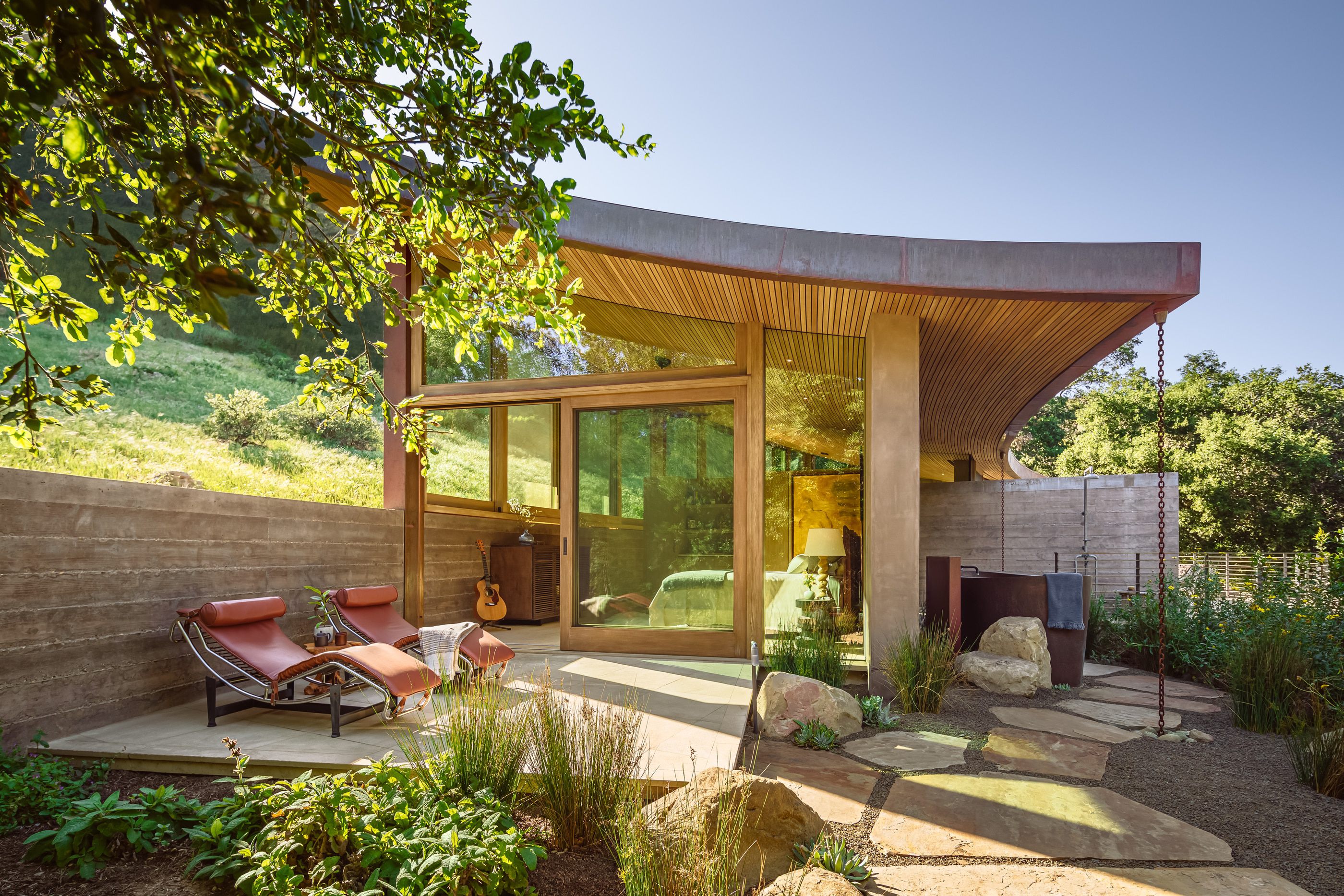
The curvilinear architecture feels connected to the landscape. Why was this sculptural approach the right response for this site? Curvilinear building forms follow the land's natural contours, reaching outward to engage the surrounding landscape and steep hillside. These tranquil radial geometries create a sense of quiet movement and flow - an architectural abstraction of Qigong meditation. Living spaces radiate along a broad, gentle curve, carefully oriented to capture the site's natural features and expansive views. Arched roofs and windows rise toward the canyon's boulder walls and extend visually
to the distant ridgeline beyond. Above, bent wood ceilings sweep continuously across the radial forms, reinforcing spatial continuity and unifying the living spaces beneath.
The property sits on a steep hillside within a mature oak woodland. What were the primary challenges of the site, and how did you address them while preserving all existing specimen trees? The design really grew out of the site itself and our desire to work with the landscape, not against it. The guesthouse and studio are separate buildings, carefully tucked in among oak trees that are more than 100 years old. We spent a lot of time walking the site during the design process, figuring out how the buildings could sit comfortably on the steep hillside while protecting the oaks and following the land's natural contours. That early effort paid off in a big way. By letting the site guide the design, we were able to minimize grading and preserve every one of the existing specimen oaks. The buildings don't feel imposed on the landscape - they feel settled, as if they've always belonged there and simply evolved alongside the trees over time.
The material palette, board-formed concrete, native sandstone, plaster, copper, and cedar is both restrained and expressive. What guided these selections? We intentionally chose rugged, natural, low-maintenance, and fire-resistant materials that feel at home in this harsh environment and will age gracefully over time. A weathered copper roof and rusted rain chains add warmth and patina, while rough board-formed concrete walls and integrally colored plaster bring depth and texture. Natural cedar ceilings and eaves soften the architecture, and stone flooring flows seamlessly from the interior out to the decks, reinforcing the connection to the landscape. The planting palette is made up of native and climate-adaptive species, carefully selected to preserve and strengthen the existing oak woodland habitat.
Board-formed concrete plays a prominent role. What qualities were you looking for, both visually and in terms of durability and fire resistance? We were drawn to board-formed concrete for its natural, rugged character and how well it lits this remote, lire-prone site. The texture left by the wood form boards - and the subtle horizontal lines where the concrete seeps between them - gives the material an organic quality that feels shaped by process as much as by design. There's something very honest about it, with a look and feel that echoes the surrounding landscape. We initially explored using just sandstone walls, but against the canyon's massive boulders, the stone felt like it was competing rather than working in harmony with the site. Board-formed concrete, especially with a warm earth-tone pigment, struck the right balance. It feels clearly architectural, yet still grounded and natural -strong and resilient, but also quiet and complementary to the hillside setting.
How does the architecture encourage a sense of quiet and connection to nature for those who stay here? It's all about the symbiotic relationship with the natural site - the way the spaces open up and flow seamlessly from inside to out. The way the views are choreographed to highlight specific natural features of the surrounding boulder-strewn canyon walls, the majestic oak groves, the distant canyon views. Everything is attuned to the narure of the site and the surroundings. Organic building forms that complement narure's forms, creating a quiet harrnony. It is truly one of the most restful and restorative designs we've ever created.
Can you speak to the collaboration involved - builder, consultants, or specialty trades - and their role in executing the design on such a challenging site? Creating a project this unique takes an extraordinary team. Thom Hume Engineers guided us in developing the structural design for the challenging curvilinear walls and roof planes. Rich and Krista Coffin and their crew at RHC Construction did an amazing job bringing the complex forms to life while preserving the trees and natural site. Matt Shaw and his team crafted the board-formed concrete walls, and Joe Matthews and his team at Architectural Millwork created custom radial doors and windows that follow the structures' arcs. Micholyn Brown and Hayely Bridges collaborated on the interiors and furnishings, perfectly complementing the serene flow and ambiance of the spaces. Scott Menzel designed the native, adaptive planting to blend seamlessly with the natural landscape. And, of course, our client, who came to us with a challenge and an opportunity to create our very best work. It was a true team effort that turned our vision into reality and made the project a design success.
Looking back, what aspect of this project best captures the spirit of your practice? We love designing homes that connect with people's unique lifestyles and the world around them. Our clients come to us wanting more than just a house - they want a home shaped around the way they live, one that's sensitive to the environment and deeply connected to the beauty of its surroundings. This project embodies that spirit beautifully.
NMA Architects is based in Santa Barbara, California. Learn more about their work and approach at nmaarchtiects.com